Author: Neil Gormley

  • Let the Wildness In: Part 2

    Soon after moving to this small town on the Potomac River, I noticed a door along the main street that bore the words “Eel Town Folk School.” I had no idea what it was, and the otherwise nondescript door offered no clues. But it sounded nature-loving and vaguely rebellious. I was intrigued.

    “Eel Town,” it turns out, is a reference to the American eel, anguilla rostrata. For centuries or longer, it was a keystone species in this river and throughout (what we now call) the Eastern U.S. Through their various life stages, eels migrated across massive distances from spawning grounds in the Caribbean and up into tiny headwater streams, even wriggling onto land when necessary to complete the migrations.

    Wild Potomac is a reader-supported publication. To receive new posts and support my work, consider becoming a free or paid subscriber.

    The local lore is that early colonizers called this place “Eel town” (or perhaps “Eel Pot”) because the indigenous people they displaced harvested so many eels from the river here. The astounding productiveness of river ecosystems in that era is difficult for us to comprehend today. And in that era of wild abundance, eels were especially abundant: pound for pound they represented about a quarter of all fish in Atlantic coastal streams and rivers.

    Now they are essentially gone. A cryptic sign on a door is the only sign of them I can find in this place where once they were famously abundant. It makes me want to know why the eels disappeared. And whether they will ever return.

    The answers take us further down the path we started on in Part I, where we asked how, concretely, we can act on the felt impulse to give to the ecosystems around us. While Part I looked at wildlife corridors, this part focuses on the river itself. The most important, immediate drivers of the eels’ decline, it turns out, are sitting right there in the river channel.

    Returning life

    For clues to what’s happened on the Potomac, we can look to the recent history of another major mid-Atlantic river artery, where eels are coming back. The Rappahannock River runs through Northern Virginia, roughly parallel to the Potomac River in places, a few dozen miles to the south. Its headwaters flow out of Shenandoah National Park. It then passes through mostly farmland—a lot of which is becoming exurban sprawl, particularly around Fredericksburg—before draining into the lower Chesapeake Bay.

    Something extraordinary is happening on the Rappahannock. In 1994, the authorities razed and removed the Embrey Dam, a large hydroelectric dam built in 1910 (and which replaced an earlier dam erected in 1855). Suddenly, for the first time in 139 years, the Rappahannock River flowed freely over its entire 195-mile length.

    The result? Over the next fifteen years, eel populations in the Rappahannock’s upstream reaches more than doubled. As eels returned to the Rappahannock watershed, they once again helped to cycle nutrients from ocean to mountains and back again. They now provide more food for osprey, raccoons, herons, striped bass, and many other species that prey on eels. They also have returned to their role as an important predator of smaller benthic fishes (those that dwell near the river or stream bottom). That effect likely benefits the benthic food web in yet unexamined ways, akin to how the reintroduction of wolves into Yellowstone enabled the reestablishment of streamside vegetation. Eels even help freshwater mussels—which attach themselves to eels in their larval stage—spread throughout the watershed, where they clean the water by filtering it. In short, returning eels infuse the Rappahannock watershed with new life and health.

    “Half-way technologies”

    Most Atlantic rivers today are not like the Rappahannock.  They do not flow freely, and eels are not returning. The Potomac River, for example, has 443 dams, blocking migratory fish from access to 88 percent of the watershed. Dams have so altered the Potomac’s hydrology that much of the main stem is more lake than river, including the 3-mile “big slackwater” above dam number 4 near Shepherdstown and the “little slackwater” above dam number 5 near Williamsport. And the Potomac is typical. There are roughly two million dams in the United States. Across the country—and increasingly across the world—almost all major inland waterways are dammed.

    Dams have coincided with precipitous declines in the populations of migratory fish. American shad, the world’s largest herring, was abundant beyond belief when the Eastern U.S. was colonized. Over 22 million were harvested from the Potomac River in 1832. Today the fishery is closed, and the population is at all-time lows. Most Eastern U.S. rivers once had salmon runs in the tens of thousands, shad runs in the millions, and river herring runs in the tens of millions. Today these populations are reduced by 95-99%, where they aren’t completely extirpated. Eel populations stand at less than one percent of historic levels.

    Most efforts to restore migratory fish today focus on constructing “fish ladders” at dams, in combination with stocking rivers with fish spawned in hatcheries. But it’s not working. One study1 of mainstem dams with fish ladders on several rivers in the Eastern U.S.—the Merrimack, Connecticut, and Susquehanna—found that, on average, less than 3% of fish successfully surpass the mainstem dams. In a typical recent year, river herring passage at the first dam on each river was 706 fish, 86 fish, and 7 fish, respectively. After decades of work and hundreds of millions of dollars spent, populations are just a tiny fraction of restoration program goals. One detail stands out to me as grimly ironic: the third mainstem dam on the Merrimac River in New England is home to an educational center focused on migratory fish restoration, but in a typical year no anadromous2 fish successfully surpass that dam.

    Relative to other fish, eels’ ability to leave the water and crawl limited distances over land may increase their success in traversing dams on the way upstream, depending on topography and other local conditions. But they encounter the same fatal bottleneck on the way back downstream: they are sucked into the turbines of hydroelectric dams and shredded.

    I also learned from the paper cited above that fish passageways aren’t new. The first laws requiring their construction were enacted in the late 1700s, and major efforts to increase fish passage in Eastern U.S. rivers were made in the early 1900s and again in the 1960s. As the group of scientists concludes from their review of this long, depressing history, it may be “time to admit failure.”

    To explain the failure at a deeper level and point the way to more promising solutions, these authors invoke the idea of “half-way technologies.” First coined in medicine, the term was used by wildlife ecologist Nat Frazer to describe conservation biology’s reliance on hatchery-raised turtles instead of addressing the underlying causes of sea turtle decline. These authors view fish passageways and hatchery fish releases as half-way technologies, and they think true recovery for migratory fish requires removing dams. To me the value of removing dams for migratory fish recovery seems indisputable. But I also think the term “half-way technology” obscures the real issue, implying that what’s needed is more technology—better information, better engineering, and more precise control. In fact, the promise of dam removal lies mainly in restoring the inherent capacity of rivers and ecosystems to heal.

    Irreducible complexity

    For me, the conclusion that successful river restoration requires empowering and supporting ecosystems—requires participation, not management—flows ineluctably from the complexity of the river ecosystems. For the more science learns about river ecology, the more complex it’s revealed to be. As summarized in another important scientific article, “The Natural Flow Regime,” the magnitude, frequency, duration, timing, and rate of change of river flows all influence river ecosystems, both directly and indirectly.3 To name just a few of the forms this influence can take: flows may determine seed dispersal, growth, and survival of plants; reproductive opportunities for insects and amphibians; and access by fish to floodplain wetlands. They even determine what nutrients are available in the water to feed microorganisms. And flow regimes are often synchronized with the life cycles of organisms, not just over the seasons of a year, but also in terms of interannual variability. When the natural flow regime is disrupted, ecological integrity declines. Usually this means the decline of specialized native species, adapted to a specific niche in an intricate web of relationships, in favor of generalist species, often non-native ones.

    I see every reason to believe that this is playing out in myriad ways on the Potomac, whose mainstem dams have significantly altered its flows. One example, I suspect, involves the Eastern cottonwood. The cottonwood, a fast-growing, water-loving species, can get very large. Individual cottonwoods have been documented to be at or near the top of lists of largest trees in several Eastern states.4 The cottonwoods I’ve seen here along the Potomac River are likewise huge, with striking, deeply furrowed trunks. And I never see younger ones. So this jumped out at me when I saw it in the literature: “a certain rate of floodwater recession is critical to [cottonwood] seedling germination because seedling roots must remain connected to a receding water table as they grow downward.”5[6] Could it be that the giant cottonwoods I see near Brunswick germinated before the construction of mainstem dam 4 in the early 20th century, when the cycles of a more free-flowing river were still aligned with their needs?

    The intricacies of the relationships between flow regimes and ecosystems are well summarized in “The Natural Flow Regime.” The authors acknowledge the difficulty of understanding the complex interactions of flow components and ecological processes with the reductionist methods of science and conclude that “a holistic view is necessary.” “[W]henever possible,” they say, “the natural river system should be allowed to repair and maintain itself.” But to me the lessons the authors do not take from their encounter with irreducible complexity are even more revealing. They ultimately endorse “enlightened river management,” rooted in better scientific understanding of flow regimes and refined environmental laws. In other words, they convincingly describe why river health depends on moving beyond the paradigm of control, then reaffirm that very paradigm.

    The fealty of even the most clear-eyed scientists to the regime of scientific river management serves, despite their best intentions, to justify dams and the moribund rivers they “regulate.” It sustains the mistaken belief that we can destroy the natural flow regime and re-engineer it ourselves. In that sense, dams are not just a cause of the decline of river ecosystems. They are a symbol of our reigning sociocultural ideology, an embodiment of our choice to control instead of participate.

    Back to Participation

    Just as it points the way to dam removal, the recent history of the Rappahannock offers clues to a solution to the deep sociocultural obstacles to a thriving Potomac River. Because the Rappahannock isn’t returning to health solely through the management decisions of the United States and the Commonwealth of Virginia. It’s also an experiment in “Land Back”: returning land to the indigenous people those governments displaced.

    What is it about empowering the Rappahannock Tribe that’s helpful for restoring a river to life and health? I am qualified only to ask that question, not answer it. So I offer the brief reflections that follow tentatively, in a spirit of humility, curiosity, and respect.

    I suspect the answer is as broad as landscape and as deep as culture. The Potomac River before colonization was not just free-flowing within its main channels; it was utterly different. The history of Brunswick helps to paint the picture. Before colonization, this place I now sit writing was surrounded by extensive marshes. Eels thrived in low lying wetlands that extended the river deep into the landscape, obscuring the fixed boundaries we impose on the river today. Indeed, not just the banks and flood plains of the river were wetter than they are today, but the entire watershed, and indeed the entire region.6 The indigenous cultures of this place interacted with the wetlands (and the wildlife in them), and they may well have extended and enhanced them, much as indigenous cultures all over the world have enhanced landscapes to the mutual benefit of humans and their other-than-human kin.7

    Much has been written about the nature of the relationship between indigenous people and the landscapes they inhabit, including by indigenous Native Americans themselves.8 This information is precious, and I cannot survey all of it here. But one account stands out to me as especially resonant with the critique I’ve offered here of the paradigm of scientific river management, and the extensive damming that it serves to justify.

    In their book The Dawn of Everything, David Graeber and David Wengrow draw on the work of Indigenous North Americans, especially Huron-Wendat scholar Georges Sioui, to argue that the indigenous peoples of Northeastern North America had a “surprisingly consistent” critique of European institutions and culture. Indigenous people were struck—and horrified—by the unfreedom of the Europeans they encountered. According to contemporaneous accounts summarized by Graeber and Wengrow, it was generally true in those indigenous North American cultures that “no one’s will” should be “subjugated to that of anyone else.” And this norm of noncoercion in turn favored a particular constellation of traits and habits—among them intelligence, respect, and cooperation.

    Does this distinctive conception of the relations between people extend to the relations between people and wildlife, and between people and a river? Other indigenous writers tell us that it does, because wildlife are kin, and waterbodies are alive. Here is Robin Wall Kimmerer

  • For Priceless Things

    How gift economies can help us come home again

    Perhaps I was an anxious kid. I remember watching television shows and movies like Conan the Barbarian and The Princess Bride, set in a far-off time vaguely evocative of the Middle Ages, and worrying when the itinerant protagonists said they had no money. How would they eat? Where would they sleep? The characters trusted in the kindness of strangers and the fruits of the land, but I could not. I had learned you can’t survive without money, and I projected the felt precariousness of our time onto theirs.

    The reality, I know now, is that our society is the outlier. Hospitality has an ancient pedigree all over the world. It’s a tenet of all the world’s major religions, still adhered to in many traditional cultures. The Yakut people, for example, when told by a Western visitor that people die of hunger in other parts of the world, refused to believe it, reasoning that one can always visit with a neighbor and share in a meal.1 Hospitality is part of the cultural inheritance of the United States too. But we’ve lost touch with those habits as more and more of what sustains us is obtained through buying and selling. As I explain in this post, these trends are part of a larger shift in our way of being, so fundamental that it usually escapes our notice.

    I’ve already touched on the dramatic growth of the money realm, considering it as one important aspect of the self-interest-driven systems I called the mercenary world. I also introduced the idea of gift economies as an alternative to market exchange and issued an invitation to take a step into gift through the Hickory Rooted Project. Here I want to describe the priceless things we lose as markets expand, and consider the potential of gift economies to reconnect us to community.

    King Midas by Arthur Rackham

    This is all part of my effort to sketch the social counterpart to a rewilded Potomac River. As together we imagine a vibrant and healthy watershed, rich in diversity and suffused with innumerable relationships of mutuality, let us imagine the same for our human communities.

    Wild Potomac is a reader-supported publication. To receive new posts and support my work, consider becoming a free or paid subscriber.

    A Subtle Poverty

    The growth of the money realm leads, counter-intuitively, to a form of poverty. In the words of Charles Eisenstein, whose Sacred Economics contains the best treatment of these ideas I’ve encountered, we inhabitants of a highly monetized society suffer “a poverty of immeasurable things.”

    As an illustration, imagine two diners in a restaurant. The first is recognized as they come in the door, welcomed, and shown to their favorite table. They chat with the waiter—How are the kids?—and share a laugh with another regular customer. The bartender knows their favorite drink, and insists this one’s on the house. Even though their favorite dish is no longer on the menu, for them the chef is happy to prepare it. Afterwards they linger a while, waiting for a rush to die down so they can catch up with the bartender and thank the chef in person. Feeling grateful, they leave a big tip.

    Now imagine a second diner who has enrolled in the same restaurant’s “premium experience” program. For an annual fee, they get to skip the line and choose any open table. They’re guaranteed a complimentary drink, and a member profile informs the bartender what they like. They get access to a premium menu that showcases the chef’s talents. The wait staff know this diner is in the premium program, so they’re extra attentive and polite.

    Even if both diners eat the same food, drink the same drinks, and hand over the same number of dollars, these two experiences feel very different. The first diner is nourished in ways the second is not. Perhaps we can describe the difference: The extra nourishment the first diner receives has to do with connection and belonging, ease and authenticity. But we cannot measure the difference, at least not with sufficient standardization and precision for science and the market. The special qualities that distinguish the first diner’s experience defy our attempts to quantify, predict, and control.

    You’ve probably had experiences like the first diner’s in your own life, where you engaged in a market transaction that wasn’t only a market transaction. This kind of experience can provoke a range of emotions for those of us raised in a highly marketized society, accustomed to the anonymity and independence that characterize pure market transactions. But we also recognize a certain status in “knowing someone here” or “having a personal connection.” The status such relationships confer grows as connection and belonging become scarcer.

    The restaurant example is just one instance of a dynamic that plays out continually in our lives. To the extent we meet our needs through pure market transactions, we may gain in efficiency and convenience, but we lose out on the connection and belonging that is reinforced each time we borrow a tool from a neighbor, share a potluck dinner, or help friends paint their house—each time we meet needs through community. When we meet needs through the market instead, even if we have all the goods and services we want, we don’t satisfy, in Wendell Berry’s words, the “need to need one another.”

    The restaurant example also makes clear, I hope, that the connection and belonging that inheres uniquely in the first diner’s experience cannot be purchased. Indeed, as soon as we attempt to buy and sell this type of nourishment, we convert it into something different, counterfeit.

    Community, by its nature, is priceless. And so is everything else that makes life worth living. Beauty. Family. Friendship. Wild nature. Joy. Play. Wisdom. Ease. Meaning. Love. All evade quantification. If we attempt to bring them within the market, we change them, shortchange them, or both. And the growth of the market realm has made them all scarce.

    The empire of money

    It may seem intuitive that the market and the priceless could co-exist, or even support one another. After all, advertising bathes us in the message that consumption of goods and services also makes us happy. Can’t we have more of both? Why should economic growth degrade our quality of life?

    The answer is that market transactions invite us into a distinctive way of perceiving and relating. Sociologists have repeatedly observed that money and markets weaken community-oriented norms. In one study, a group of people paid a commission collected less money for charity than another group that received only a motivational speech. In another, introduction of a fine for late pickups at a day care increased the rate at which parents arrived late. In both these cases (and others), introducing money “crowd[ed] out moral and civic commitments,” according to the philosopher Michael Sandel.2

    So how does this happen? One way of answering the question is to observe that markets atomize, separating us from one another. A market transaction leaves the participants “even.” No one is indebted to anyone else, so they have no enduring connection either. Not only that: a market transaction is one in which we look out for ourselves, one which invites us to view our interests as in competition with those of the person or entity with whom we transact. The (often implicit) negotiation is zero-sum: If I pay more, I lose and they win. And vice-versa.

    The atomization and orientation to self-interest produced by the market lead in turn to the scarcity of priceless things. Because without cooperation and generosity—without mutuality—any social phenomenon that cannot be purchased (or compelled) withers.

    While it is possible to engage in market transactions within a context of relationship, the transactions don’t contribute to the relationship. In this sense, as James Scott observes, markets are “parasitic” on social trust: They require it, but they draw us into ways of being that do not replenish it.3 This is in contrast with the dynamics of a gift economy, which I’ll say more about below. Money transactions may even weaken a relationship. Imagine charging your kids for their dinner, or paying rent to your spouse. Some families may do these things, but with time regular money transactions will make a family more like housemates than intimates. As Louis Hyde puts it, money transactions “will either be missing or frowned upon to the extent that the group thinks of itself as one body.”4

    At a deeper level, market transactions are rooted in, and reinforce, a distinctive way of attending to the world. When we inhabit a market mindset, we draw upon the analytic, reductionist, and instrumentalist mind that Iain McGilchrist describes at length in The Master and His Emissary. We tend to see the elements of the world around us as objects, not subjects, and to evaluate them in terms of their utility to us. “Whatever lies in the realm of the implicit, or depends on flexibility, whatever can’t be brought into focus and fixed, ceases to exist . . . .”5 Under the sway of this way of thinking, we reduce priceless things to utility, or deny them entirely. And so we lose sight of what we have lost.

    It would be one thing if markets and their associated attitudes could be kept in their place, employed where they are useful but prevented from expanding into other areas of life and society. Alas, the money economy is, in Michael Sandel’s words, an “imperial domain.”6 The realm of money must grow, converting more of what we formerly received from nature into goods, and more of what we received from community into services.7 And so the money realm colonizes more and more of the world—which, after all, is finite. Each of us has only so much time, attention, and need. And the Earth has only so much land, life, and wildness. The more we measure, quantify, buy, and sell, the less remains of the priceless.

    The glimmer of mutuality

    It sounds bleak I know. So much has been lost, and the money realm continues to expand. But other ways of being are available to us. By meeting our needs differently, we can attend to the world differently. What Ivan Illich calls “the glimmer of mutuality” is available through an alternative mode of economic organization that few recognize as the potent form of resistance it is: gift.

    It won’t surprise me if my invocation of gift leaves you cold. For much of my life, I viewed gift giving as an idiosyncratic, even frivolous custom. I was deeply skeptical of the suggestion that it could be an important organizing principle for our collective lives. Now I think it can be just that. And I view my skepticism of gift (which on some level I still carry) more as a reminder of how far we’ve strayed from gift culture.

    It’s worth clarifying that when I say gift, I don’t mean barter. As David Graeber tragi-comically explains in Debt: The First 5000 Years, the “myth of barter” runs deep, especially among economists. According to that ahistorical view, barter was the predominant form of economic organization before money. In other words, humans have always met their needs through arms-length market transactions, and money just made those transactions a lot more convenient. Except, as Graeber documents, it didn’t happen that way. In actual fact, before money, economies were predominantly organized around relationship, reciprocity, and gift.

    It’s no surprise that modern economists, steeped in market logic, anachronistically project barter backwards onto traditional cultures. Because barter is just a market transaction without money. In barter, the price I charge for corn may be expressed in fish or blankets, but I still demand payment in exchange. A gift, by contrast, is not conditioned on receiving in return. In Louis Hyde’s memorable phrase, we give gifts “around the corner.”

    Functional gift economies and vibrant gift cultures require more than just the giving of gifts, however. They also require that others be open to receiving, unafraid of the indebtedness that inheres in receiving a gift. Only when we fully acknowledge receipt of a gift, “only so long as the debt is felt,”8 do we feel gratitude and the corresponding desire to give in return.

    As I mentioned above, I now think my experiences with gift giving are a sign of how far we’ve moved away from gift culture. I find the gift-giving traditions I was raised in, like at birthdays and at Christmas, somewhat stressful. I often fail in those situations to tap into a genuine desire to give, and I end up giving out of a sense of obligation instead. I think this tendency is related to the difficulty of appreciating gift’s deeper logic, because that logic conflicts with the primary messages we receive from society—that we succeed or fail as individuals, and ultimately need to look out for ourselves.

    Another reason gift giving can be challenging is that it’s hard to consummate the desire to give well and generously in a highly marketized society. Part of that desire, when I feel it, is wanting to put something of myself into the gift. But how do I do that when I know people could simply buy what I’m giving? Likewise, to give well and generously means meeting a need. Yet giving in our culture often means buying more consumer goods for people who have a lot already. There is unmet need all around us, but our gifts largely fail to meet it. Until we reconnect gifts with needs, gift giving will feel blind to context, even frivolous.

    My experiences of not giving tell me something about our culture too. I’ve lived a lot of my life in cities, and I’ve had countless experiences of encountering panhandlers on the street . . . and continuing on past. Those situations always made me feel vaguely guilty, but also fearful and hopeless in the face of what seemed like bottomless need. My despair in those situations is a product of the intuitions of our highly marketized society, born of systems that both assume scarcity and enact it, and that invite us to see ourselves as separate from those around us, our interests in conflict with others’ wellbeing. 

    Gifts resonate with a different set of intuitions. That there is enough for all. Gifts naturally move toward the empty place and enable the meeting of needs without the necessity of taking from anyone. That my wellbeing is inseparable from yours. Gifts not only invite us to give attention to the needs of others, they connect us with others until the distinction between others’ needs and our own softens. That the gift is to the giver. Gifts attune us to the satisfaction and fulfillment born of giving to good purpose. That life is a gift. Gifts teach us that we do not engineer our wellbeing; we receive it. We are not “even” with the world that sustains us; we are in its debt. And by that realization we access gratitude. That the world is a community of subjects. By orienting us to the needs of others, and disabusing us of the notion that we can or must engineer our individual wellbeing, gifts help us treat others as ends in themselves.

    Stepping into gift

    In Sacred Economics, Charles Eisenstein distills all of this into a simple prescription: Grow the community, not the economy. Because meeting needs through gift offers a path to both material abundance and more of the priceless things that make life worth living, including a thriving Potomac River.

    That’s the inspiration for the Hickory Rooted Project, our experiment in building a gift economy that roots us in land and community. But Hickory Rooted is just one of countless ways to step into gift. All it takes is giving attention to what you receive. And noticing when you want to give.

  • Let the Wildness In: Part I

    As I move into relationship with the river outside my window, I’m more motivated to help it thrive. But that doesn’t mean I know how to help. So I wonder: What does the river need?

    In this post I want to explore one possible answer to that question: connectivity. Ecology teaches that the health of an ecosystem depends on its complexity, in terms of the number and diversity of organisms and also the connections between them. Complexity, so understood, is part of the essence of wildness. It cannot be forced, or “managed” into existence; this type of health has to emerge. But we can make space for complexity, and even participate in it. By protecting habitats, restoring connectivity between them, and ditching our habit of suppressing wildness, we can give ecosystems opportunity to heal.

    Wildlife corridors

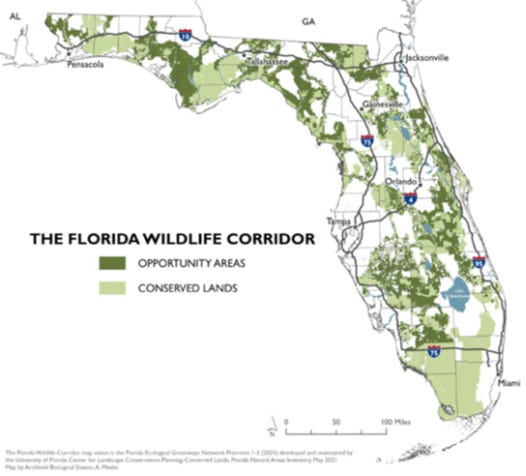
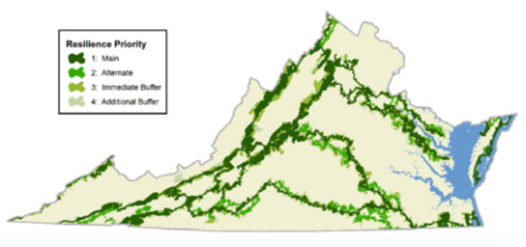
    The inspiration to serve this role is upwelling all around us in movements to establish wildlife corridors—strips of intact habitat that connect larger areas of healthy habitat to each other, enabling wildlife to move between them. Virginia, for example, passed legislation in 2020 to establish a Wildlife Corridor Action Plan and has identified biodiversity corridors that crisscross the state. Florida passed a Wildlife Corridor Act a year later, mapping out a corridor from the Everglades to Pensacola and earmarking money to conserve private lands within it. The Center for Large Landscape Conservation and the Wildlands Network envision an “Eastern Wildway” running from Louisiana to Maine and beyond, and have mapped both areas of high quality habitat and the corridors needed to connect them.

    Virginia biodiversity corridors

    I find it thrilling to think about how the land around me could contribute to a continent-spanning effort to aid wildlife. Central Maryland, according to a recent report by the Climate Change Working Group of Frederick County, could form part of an “Appalachian Climate Corridor.” Species need to migrate as the world warms, and the Appalachian Mountains are already a key a migration route.

    Appalachia is a globally important center of biodiversity, with reservoirs of ecological health that carry the potential to contribute to the healing of the region and the world. The mountain range is home to over 250 species of birds, 78 mammals, 58 reptiles, and 76 amphibians, and its mussel, fish, and crayfish richness is unparalleled worldwide. Tennessee alone has at least 290 fish species, more than all of Europe combined.

    But these ecosystems are under threat. Almost 200 species found in Appalachia are already federally listed as threatened or endangered, and petitions to protect hundreds more are awaiting action from federal wildlife agencies. As you can see in the Nature Conservancy’s Migrations in Motion map linked here, the central and upper reaches of the Potomac River watershed are part of the migration route for species moving north along the mountains—a route that will become even more important as temperatures continue to rise.

    The Blue Ridge Mountains, including the Catoctin and South Mountain ranges of Frederick County, are situated at the Eastern edge of the Appalachian Mountains, enabling them to serve as a bridge for plants and animals needing to migrate upslope and north from the piedmont and the coastal plain. The C&O Canal Park and the Potomac River itself have the potential to serve as corridors too, connecting points East and West with the Blue Ridge Mountains, the Appalachian Trail, and the Allegheny Mountains. And establishment of wildlife corridors would support the healing of the river, especially if they center on its tributaries. Yet the connectivity between these potential corridors is uncertain. Current assessments show some intact forest and a lot of privately owned, largely undeveloped land, but little in the way of durable protections.

    Activists here in Western Frederick County are realizing that protections are needed now, before the farms and homesteads that currently predominate are replaced by subdivisions and strip malls, data centers and distribution hubs, all run through with wider, busier roads. We live along the blurry line that is the suburban-rural interface, at the outer edge of the growing sprawl. There is remarkable bipartisan agreement at the level of the citizenry that we should chart a different course; few want Frederick County’s Middletown to become another Ashburn. But the institutions of the mercenary world have us marching in that direction. Wildlife corridors offer a way to soften the blow, preserving some room for wildlife amidst the expansion of human infrastructure that’s mostly incompatible with their thriving.

    Intelligence in the landscape

    To fully appreciate the power of inviting wildness in, it helps to apply the core idea we’ve explored in prior posts here at Wild Potomac—mutually enhancing relationship between humans and ecosystems. For one thing, because there can be no relationship with something inert, the lens of relationship calls our attention to the intelligence and agency of non-human beings, individually and collectively. This is not to say that the intelligence of an animal, plant, or ecosystem is like human intelligence. But all living beings have the potential to give and take with each other and their environments in ways that enhance the whole, creating, in too many ways to catalog, the conditions for more life. So by making room for wildness, we enable not just a proliferation of organisms, but the emergence and operation of intelligence at the level of ecosystems. That intelligence can be our ally in the project of healing.

    The lens of relationship can also help us move beyond mechanistic assumptions and one-way causality, including in how we think about climate change and biodiversity. Yes, warming has dire consequences for wildlife, and increased connectivity can make wildlife more resilient to climate stressors. But climate warming is not a purely mechanistic phenomenon exogenous to the health of ecosystems; a stable climate is part of the life-supporting conditions that healthy ecosystems maintain. Humans are disrupting the Earth’s climate balance by pumping fossil fuels into the atmosphere, turbocharging the greenhouse effect, but also by cutting down forests, tearing up grasslands, paving over wetlands, dredging ocean floors, nitrifying estuaries, poisoning insects, and disrupting Earth’s living systems in a million other ways. The converse is also true: everything we do to protect ecosystems and participate in their healing, including establishing wildlife corridors, contributes to the healing of Earth and its capacity to maintain homeostasis.1

    When we adopt the lens of relationship, in other words, we come to see the world around us as full of intelligent beings, and Earth itself as a being. The ground shifts beneath us, and our understanding of the possible shifts too. We can begin to ask not only “what does the river need?,” but even, as Georgian poet Lela Samniashvili does, “what does the river want?”

    Life, suppressed

    Our dominant institutions, including even our institutions of wildlife conservation, operate from a very different understanding. Far from making space for the intelligence and agency of ecosystems, they control and suppress wildness in countless ways.

    A neighbor tells me that once, not so long ago, we had beavers and muskrats around the Potomac River here in Brunswick. He thinks they may have been locally eradicated through trapping, which wouldn’t be unusual. At both the state and federal levels, our government maintains an active program to suppress the population of native mammals. Every year, licensed trappers kill millions of “furbearers,” a category that includes gray and red foxes, weasels, minks, opossums, otters, raccoons, coyotes, fishers, and, in other states, bobcats and wolves. This “population management” is carried out in all our names, based on the belief that the public views these animals as nuisances. The Maryland Department of Natural Resources sees dam-building by beavers, for example, as a threat to commercial forests, agriculture, septic systems, and ornamental trees.

    These programs don’t seek to eliminate species outright, but they are successors to the eradication programs of the 18th and 19th centuries in their view that significant local wildlife populations are incompatible with humans. And they operate to maintain populations at levels low enough to eliminate or drastically dilute the effects they once had on the landscape, suppressing the intelligence of these ecosystems. To again take beavers as an example, the North American beaver population, estimated at 60 to 400 million pre-colonization, today hovers around 10 to 15 million. Where once beavers played a key role in bringing life to our lands and waters, today their impact throughout much of the Potomac River watershed is minor or non-existent.

    We also suppress wildness systematically and at large scale using poisons. Many states, including Maryland, spray toxic substances from airplanes to kill mosquitos, killing a lot more than mosquitos in the process. According to the Environmental Protection Agency, which authorizes the use of chemicals for this purpose, they are “slightly toxic to very highly toxic” to birds, “moderately toxic” to mammals, and “highly toxic to very highly toxic” to aquatic organisms. One of these substances, naled, is the “pesticide”2 most commonly sprayed from airplanes, and the one used in Maryland.

    I even see this pattern—the habit of suppressing wildness—playing out on my street. As I write this, a neighbor is removing a huge maple tree from their yard. In the three years I’ve lived here, on street called Maple Avenue, several large silver maples have been removed within a few blocks of my home. No silver maples, or any other full-size trees that I’m aware of, have been planted. Part of our logic is that a full-size tree could someday require costly maintenance, or even fall onto a house. But already the flocks of starlings and grackles have fewer places to congregate.

    I don’t intend to criticize my neighbors. I don’t know why the most recent tree was removed, and it’s possible I would have done the same in my neighbor’s shoes. Sometimes the best choice is to cut down a dying tree before it damages all beneath it. But collectively, as a neighborhood, we are gradually eliminating the few spaces still fit for wildlife amidst our homes. And when I planted two small trees in front of my house a few months ago, the town made me dig them up. Their policy, it turns out, is to prohibit street trees out of concern that they could damage sidewalks or utility lines.

    In all of these decisions about how to relate to wildlife, we are choosing management and control over mutual nourishment. The risks to our parochial human interests loom large, while the needs of other species, and of the Earth itself, recede. Even the modest unruliness of a street tree, in this view, is too much wildness.

    Wild Potomac is a reader-supported publication. To receive new posts and support my work, consider becoming a free or paid subscriber.

    All the world a corridor

    If we take a wider vantage, we can see that a vision of the future centered on wildlife corridors remains, despite all their promise, impoverished. Implicit in the call to preserve or establish strips of habitat lurks the expectation that the rest of the landscape—most of it—will remain inhospitable. And perhaps the drive to map hubs and corridors for wildlife, even as it draws upon genuine wisdom and generosity, also reflects habits that are out of place in a relationship of mutuality, like the inclination to confine and control.

    What would it look like to imagine instead a future in which wildness emerges throughout the landscape, with humans relating to that emergence as participants and contributors?

    One way to start is by turning our yards into havens for wildlife. With his vision of a “Homegrown National Park,” entomologist Doug Tallamy invites us to do just that. He points out that we can dramatically enliven the ecosystems of the continent by replanting the 40 million acres of land across the U.S. currently maintained as ecologically barren lawn with gardens of native plants. For me, the surging movement to support wildlife by planting natives is confirmation that people are ready to embrace relationships of mutuality with non-humans, and that rapid change is possible.

    Our food systems could support wildlife too, instead of displacing and destroying it. Farms could become rich mosaics where healthy soil, plant diversity, and human attentiveness make “pesticides” obsolete. And we could shift from annual cropping systems that draw down ancient aquifers towards perennial agriculture where trees (including yellowbud hickories) feed us even as they recharge aquifers, build soil, cool surface water, and shelter animals. Even commercial built spaces could welcome wildlife. Instead of preparing sites by flattening large areas, scraping away topsoil, and leaving the land mostly dead, we could welcome wildlife each time we build, designing for water retention and making space for healthy native trees and plants.

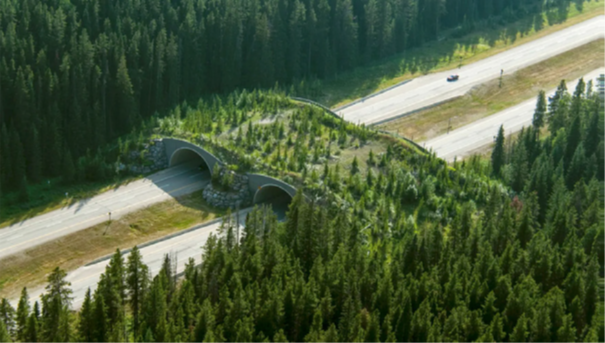
    We could redesign our transportation systems to protect wildlife. Already there are efforts to enable wildlife to cross roads and highways safely, like the wildlife bridge in Canada’s Banff National Park shown below and, closer to home, wildlife underpasses along Maryland’s Intercounty Connector highway. We could install such crossings anywhere we continue to use automobiles at high speeds, reducing the devastating toll of roadkill.

    True, some species require rarefied habitats, like unbroken interior forest. There’s less potential to invite those species into spaces occupied by humans. But even in those cases, there’s good reason to think we could tend the land in ways that meet their needs and ours. Consider the evidence—including the over-representation of trees used by humans in proximity to past human settlements—that the forests and soils of the Amazon rainforest have been shaped and enhanced by indigenous peoples. Or the testimony of people indigenous to what we call North America that they shaped forests and grasslands in ways beneficial to both humans and other species. The ancient old growth forests of the Potomac River watershed are essentially gone, but they whisper of what’s possible.

    We could do all these things and many more besides, not out of obligation, but because they are wondrous, beautiful, and satisfying in their own right. Each is an opportunity to practice what Ivan Illich calls “conviviality”: free and spontaneous action, realized in relationship.

    Perhaps no question is more complex than how to make change at the intersection of social and ecological systems. If we think we’ve reasoned out the “right” approach, we’re probably missing something. But intuition can do things rationality cannot, and we respond more skillfully to complexity and context when we heed our embodied mind also. So let’s learn to notice and trust the tug we feel towards certain actions. The best gifts are those we feel called to give.

  • Hickory Rooted

    Building a gift economy that roots us in land and community

    In this shorter post, I want to share one concrete way we can step into a different relationship with each other and our non-human kin in the Potomac River watershed. It’s called the Hickory Rooted Project.

    On my recent outings to the C&O canal towpath, I’ve been clumsier than usual, more prone to trip and fall. Instead of paying attention to where I’m treading, I’m mostly looking around at the trees. That’s because lately I’m on the lookout for one species in particular, carya cordiformis, the native yellowbud hickory. In just a few weeks, if the weather cooperates, our local yellowbuds are going to start dropping their bounty: smallish yellow-green nuts with distinctive ribbed husks. I don’t recommend eating them though. The yellowbud nuts are bitter enough to justify their other common name, “bitternut.”

    So why am I focused on this tree? It’s because the tannins that make the nut bitter are water soluble, not oil soluble. That means that when the dried nut is pressed for oil, the bitter tannins stay behind. The result is a rich, flavorful, versatile oil, great for everything from sauteing to salad dressing.

    In the last post (A Mercenary World) we explored how relationships of mutuality or kinship – we could also call them gift relationships – became marginalized in our society. I talked about how market logic “increasingly governs the whole of life,” replacing mutual interdependence with commercial transactions, and relationship with rules. I closed the post by saying this:

    “We have an open invitation to receive what the world offers us with gratitude and attune to what the more-than-human beings around us need.”

    Well, one thing the world is offering us around here is hickory nuts. They fall from the trees every year, and lie on the ground waiting for us to notice them (unless the squirrels get them first). These nuts are hickory trees’ gift to the world, and I think they can help us build gift relationships as well, both with the natural world and with each other. That’s why they’re at the heart of the Hickory Rooted Project, an experiment in building a gift economy that roots us in land and community.

    Read on to learn more about the project. If you’re interested in getting involved, tell me in the comments, or send me an email (at my personal address or wildpotomac@gmail.com).

    About the Hickory Rooted Project

    Hickory Rooted, a joint project of Wild Potomac and the REED Center for Ecosystem Reintegration, is an experiment in building a gift economy that roots us in land and community. Its mission is community-scale production of nut oils from wild-foraged and regeneratively grown tree nuts.  

    We hope to experiment with several tree nuts, but right now we’re most excited about yellowbud hickory, carya cordiformis. This native tree produces a bounty of nuts that can be pressed into a delicious, versatile oil. And they may be growing in your backyard already.

    You’re invited

    You’re invited to help us make hickory oil by bringing us wild-grown, locally foraged nuts. On designated days this winter, we’ll be running our commercial-scale oil press as a gift to the community. The oil we make from your nuts is yours to keep. Your return gift to us can be as much or as little as feels right to you and can take the form of money or a portion of the oil. And if you feel moved to, you can also give to the ecosystems that sustain our wild hickory trees.

    Frequently Asked Questions:

    What nuts should I bring?

    For this project, you should only bring yellowbud, aka bitternut, hickory nuts (carya cordiformis). These should be nuts that you forage or grow yourself, not purchased nuts.

    When should I bring nuts?

    Stay tuned for exact dates this fall and winter. We are planning to schedule a day when you can drop off fresh nuts for curing at the REED Center and one or more pressing days when you can bring cured nuts and receive your oil.

    Where should I bring nuts?

    We’ll store nuts and make oil at the REED Center. Contact wildpotomac@gmail.com for details.

    Why yellowbud hickory nuts?

    Yellowbud hickories are an abundant and untapped wild food source in our region. Although the nut is high in tannins and bitter to the taste, the bitter tannins stay behind when the dried nut is pressed for oil. The result is a tasty, versatile cooking oil high in healthy fats.

    How do I identify yellowbud hickory trees?

    As their name implies, yellowbud hickories have distinctive yellow buds in spring. During warmer months and into the fall, they have alternate leaves with 7-11 lance-shaped leaflets. Their bark is gray and rough, but smoother than most other hickories. The oval-shaped nuts, at least a few of which can usually be found near the trees throughout the year, are larger than most acorns but smaller than the nuts of most other hickories. The nuts have a thin husk with 4 ribs that begin at one end and stop in the middle of the husk. Ripe yellowbud nuts tend to drop between late September and mid-November.

    Where can I find yellowbud hickory nuts?

    Yellowbuds are one of the most common hickories in our region. Download the Falling Fruit app to give and receive information on where to find yellowbud trees where foraging is allowed.

    What is a gift economy?

    A gift economy is a way to exchange resources and meet needs through giving and receiving in community. In contrast to a market economy, no prices are charged in a gift economy. A gift economy relies instead on the innate desire of those who have received to give in return.

    What should I give as a return gift?

    We trust you to give the return gift that feels right to you in the circumstances. If it feels right to give nothing in return, that’s ok. (Really!) And if you feel motivated to give generously in return, we hope you trust that feeling too. Both money and a portion of your pressed hickory oil are welcome return gifts.

    For anyone who wants the guidance of more information, Wild Potomac and the REED Center are collectively incurring significant costs in both time and money to make the Hickory Rooted Project possible. Some similar processing operations charge a price equal to ½ the value of the finished product. Yellowbud hickory oil retails for about $65 per quart. Results vary, but 5 gallons of good-quality, cured nuts will typically yield around ½ gallon (2 quarts) of oil.

  • A Mercenary World

    “Mercenaries . . . are at once useless and dangerous . . . disunited, ambitious, insubordinate, treacherous . . . . And this because they have no tie or motive to keep them in the field beyond their paltry pay, in return for which it would be too much to expect them to give their lives.”

    -Niccolò Machiavelli

    The first post in this series discussed the potential of a rewilded Potomac River and introduced the idea of relationships of mutuality or kinship between humans and the world around us. In this second post, I want to explore how that way of relating has been marginalized in our society and how we might begin to recover it.

    If you’ve joined us mainly for discussions of water quality, fish, pawpaws, and the like, you should prepare yourself for something different today. This post focuses on making connections between the health of the river and deeper patterns in our society, culture, and economy. I promise there will be lots about trees in post number three.

    Why so much talk about relationships, in a blog about a river? It’s because I believe the quality of the relationships between humans and the world around us is key to restoring the river and watershed to health and abundance. Indeed, I doubt a thriving river is even possible without recentering mutuality.

    The Nature of Mutuality

    Let’s start by getting clear on what I’m talking about. By relationships of mutuality or kinship, I mean relationships in which it feels good to give. The animating force of these relationships is the one I described in the first post, where I talked about the feeling I couldn’t name at first – the desire to give. The origin of this desire is difficult to pin down, because its essence is dynamic and interactive. But one could say it begins with a gift. When we receive a valued gift – it could be a sweater, a son, a serviceberry, a ray of sunlight – and recognize it as a gift, the feeling it naturally provokes is gratitude (accompanied, no doubt, by related feelings like connection and belonging), and a corresponding desire to give in turn.1 When acted on, the desire to give contributes to these feelings in another. Gift – gratitude – gift. A virtuous circle of mutuality.

    If you’re like me, you’re not used to thinking about life in these terms. Instead of this effortless, intrinsic motivation to give to others, most of us are more familiar with the alternative – extrinsic motivation, aka carrots and sticks. Systems based on extrinsic motivation assume that, in the absence of rewards and punishments, we do not want to act for the benefit of another. We must, therefore, be made to. This way of thinking is pervasive in the dominant global culture, and it has built a mercenary world.

    For extrinsic motivation is what makes a mercenary. As Machiavelli (who knew a thing or two about cynicism) said in The Prince, a mercenary’s defining feature is their lack of “tie or motive.” Without love of country, loyalty to a people or leader, or emotional commitment to the cause, their will to fight must be induced with money. The motivation so produced is partial, insufficient to spur them to “give” their lives, and inferior, resulting in self-interested behavior (“ambition”), disunity, even treachery.

    Though you and I may not be called to battle, the quality of our motivation is no less important in shaping our impact on the world. Today there is a growing social-psychological literature exploring intrinsic and extrinsic motivation and their respective consequences. It shows that when we act out of intrinsic motivation, we are more attuned to complexity and context, more skillful at performing non-routine tasks, more resilient, flexible, and creative.2 We are more likely to bring our whole selves to an activity, because we see it as its own reward, not mere means to end. Fully present to the world, we are able draw on emotion, intuition, and embodied knowing, giving us insight that instrumental rationality alone cannot.

    All of these capacities become available to us in relationships of mutuality. They shrivel when we navigate by self interest instead, as our mercenary world encourages. And this dynamic has a profound effect on the ecosystems around us, and on the river. By both dulling our capacities and narrowing our focus, orientation to self interest deprives the more-than-human world of our gifts.

    The Triumph of Self Interest

    To begin to recover mutuality, we need to better understand how we lost touch with it. One major way that the dominant global culture has marginalized mutuality is by marginalizing cultures that practice it. Many scholars indigenous to (what we now call) North America attest that ideas of kinship with more-than-human beings were central to their peoples’ identities and lifeways before colonization and, to the extent that those cultures have survived genocide and forced assimilation, remain so today. This is perhaps most succinctly epitomized by the Lakota phrase “all my relations,” which recognizes kinship with all creatures, not just humans. As described in, for example, Winona LaDuke’s All Our Relations: Native Struggles for Land and Life, the phrase has long been an organizing principle and rallying cry for indigenous North American activists seeking to defend and promote ecological health. To take another example, Robin Wall Kimmerer, an enrolled member of the Citizen Potawatomi Nation who is also a botanist, ecologist, and professor, tells of how the Anishinaabe word “aki,” which means “earthly beings,” facilitates a “grammar of animacy” in that culture. To promote habits of kinship among English speakers, Kimmerer proposes that we adopt “ki” (singular) and “kin” (plural) as new pronouns to refer to more-than-human beings, rather than using “it.” These are just a few examples of the many who keep the flame of indigeneity alive, and they have so much to teach the rest of us. But they engage that struggle precisely because indigenous cultures and their associated worldviews – on this continent and every other – have been marginalized by the institutions of the mercenary world.

    One such institution is the educational system, which teaches no lesson more comprehensively than self interest. Those of us who experienced traditional K-12 schooling in the United States can probably remember moments when we glimpsed the arbitrariness of the program, when we responded to the assigned tasks – filling out a worksheet, say, or reading a textbook – by wondering why. As that experience is repeated over and over, and normalized by adults, children become accustomed to floating in a sea of abstraction and decontextualization. Year after year they hunger, if mostly unconsciously, for some connection between their daily labors and their lives and communities. But mostly that relevance comes only through grades and report cards – benchmarks of individual achievement. Living with this as the primary feedback mechanism, the primary way that school is made real and relevant to the world outside the walls, children are taught that their own success or failure is unrelated to the success or failure of their classmates, or even that their classmates are their competition. They learn the lesson that what matters is their individual performance, which will shape an individual future.

    These lessons are reinforced at home. An acquaintance of mine once shared the story of her young child’s stubborn inclination to give away her money. The child, probably four or five at the time, liked to make gifts of her paltry savings, which I assume she had received on birthdays or as an allowance, to parents and siblings. Her parents, worried that their child’s inclination to give was imprudent, sat her down and explained that she should keep her money, because if she gave it away she would have none left to buy things for herself.

    This acquaintance’s advice to her child was simply a somewhat more explicit version of the lessons we all learn in our society – an expectation of scarcity and an orientation to self interest. In a subtle way we teach children these lessons even when we try to teach the opposite. When we make children share, for example, we subtly communicate that giving needs to be forced, and deny the reality in which giving is effortless. We forsake the possibility that our children could feel joy and autonomy in giving, and leave them feeling deprived of something instead.

    Perhaps you find the same doubt (that giving can be effortless) within yourself. That’s not what our culture teaches us, after all. If so, consider looking to other cultures that attest to a different set of possibilities. One example is from Jeremy Lent’s The Web of Meaning, where (at page 252) he describes an important current of Chinese neo-Confucianism:

    Rather than having to learn altruism and generosity ‘because we are born selfish’, the Chinese view was that one simply had to unlearn the layers of misconceptions that society placed on a person as they grew up. Sagehood, Wang Yangming [a Chinese statesman, general, and Neo–Confucian philosopher who wrote in the early 16th century] taught, was a quality innate in every human, an inborn capacity to know what is good and to recognize that self-centered desires only take one away from fulfilling the true potential of human experience. . . . Because of this sense of intrinsic goodness, the Chinese didn’t believe that acting morally required the exercise of willpower. Instead, it required the practice of discernment: distinguishing between what was truly good and what only appeared attractive. As one became more adept at discernment, the impulse to act ethically would become increasingly effortless and spontaneous. Mencius [a Confucian sage believed to have lived between 600 and 200 BCE] likened it to learning how to dance. “When such joy is born,’ he declared, ‘it cannot be stopped. Since it is unstoppable, you cannot help but begin to unconsciously dance along with your feet and wave your hands in time with it.”

    I will need to save further discussion in this vein for another post. There is so much to explore, this post is getting long already, and I want to pay other cultures the respect of not rendering them as caricatures. But contemporary science confirms the teaching of ancient wisdom traditions that giving can be effortless. Experimental evidence indicates that babies are born with “empathy, compassion, and generosity, along with a clear ability to distinguish between kind and cruel actions.”3 And in The Master and His Emissary, the neuropsychologist Iain McGilchrist explains in amazing depth and detail how humanity’s robust capacity for altruism has been suppressed by features of our environmental and cultural context that favor competing ways of attending to the world. McGilchrist explains (at page 171) that marginalized parts of the human psyche have a “disposition of care” towards the world, rather than a disposition of control. For these parts of ourselves, cooperation is rooted in “[m]utuality, not reciprocity, fellow-feeling, not calculation.” Cooperation, McGilchrist emphasizes, is neurologically pleasurable.

    Likely even harder for many of us to accept is evidence that the dominant cultural and religious systems of Christian Europe, at an earlier stage of history, centered mutuality and gift as well. As Lewis Hyde discusses in The Gift: Creativity and The Artist in the Modern World, early Christians lived a form of communism. Concretely, among other things, this meant a prohibition on usury. For just as we might worry today about what lending money to a family member at interest might do to the relationship, early Christians understood that charging interest displaced mutuality and love in favor of separation and competition. For the early Christian church, the “brotherhood of man” was not merely figurative: it meant that all people should be brought within relationships of mutuality. Christianity attempted to reconcile Jesus’s instruction to live in universal brotherhood with the competing imperatives of empire and the gradual rise of commerce and capitalism, with greater and lesser success, for fifteen centuries. At that point, the Reformation settled the dispute in favor of commerce, changing the common understanding of Jesus’s teachings so completely that few today, including those who may consider themselves Christians, understand Jesus’s command of universal brotherhood as a rejection of our reigning economic and social systems.

    The life’s work of Ivan Illich was describing how the central teaching of Christianity devolved from one of mutuality – grace and love freely offered, as a gift or “gratuity” – to one of obligation. He summarized this subtle but extremely important shift with the Latin phrase corruptio optimi pessima, which translates as “the corruption of the best is the worst.” To read Illich, especially his dialogues with Cayley near the end of his life, is to feel his despair at the gradual marginalization of love and gift within Christianity and the secular societies that grew out of it.

    The legacy of this “corruption” of mutuality is that our society’s dominant systems both assume self-interested behavior and impel it. Corporations, perhaps the most powerful institutions in contemporary society, are constituted to minimize the possibility and practice of mutuality. Configured to value shareholder returns above all else, they act for the benefit of others, including non-human beings, only to the degree that they are incentivized to do so. More broadly, as described by philosopher Michael Sandel, markets and market thinking crowd out other ways of relating, such that the “logic of buying and selling” “increasingly governs the whole of life,” exerting a “corrosive effect on [norms] of giving.”4 As Illich put it in a dialogue with Cayley, “[i]t has become almost impossible for people today . . . to think in terms of relationship rather than rules.”

    Coming Home to Mutuality

    As habits of mutuality that once came easily to us have been displaced by habits of self interest, our behavior towards the more-than-human world has changed accordingly. Yet non-human beings have not changed their habits in response – at least not enough to make a difference to the outcome. Non-human beings have not learned to engineer artificial scarcity, withhold, or drive a harder bargain. They continue to live in interdependence with one another, and to offer us their gifts. So when we navigate by self interest in our relationships with them, untempered by care, non-human beings lose. This is the extractive economy.

    In the mercenary world, the answer to the ascendancy of extraction is to prohibit its worst harms, or mandate mitigation and compensation, and to enforce these rules with rewards and punishments. But extrinsic motivation is a blunt instrument, as we’ve seen. Some things cannot be forced, like love, joy, and deep commitment. Equally, we cannot force the actions that flow from these states. When we try, what we compel is a mere simulacrum of the real thing. Something important is missing. Because before we can compel, we must externalize knowing, define and quantify it. We must make the implicit explicit, the embodied abstract, and the complex simple.

    And the needs of the river are anything but simple. The conditions that give rise to its health and abundance are immeasurably complex, because the river’s health is inextricably connected with the health of ecosystems throughout the watershed (and beyond). In an important sense, the distinction between the river and the watershed is illusory: the river is the watershed, as we can see each time it rains, or by considering the interconnections between river and streams, surface water and groundwater. Healthy ecosystems are therefore inseparable from a healthy river. They sequester chemicals and carbon, enable the flow regime to which river wildlife is adapted, recharge aquifers, keep water temperatures low, and much, much more. And each ecosystem is itself a complex system, whose health, or lack thereof, is a complex matter too.

    How do we compel the healing of the river, which is to say the watershed, which is to say the ecosystems that comprise it? Our attempts to do so are bound to fall short. No regime of control can marshal insight and understanding, or exercise judgment and skill, sufficient to restore the river to health. Yes, sometimes we must work within the mercenary systems that dominate our society. But that is not enough. To really heal the river, we must let a million relationships of mutuality bloom.

    How then might we recover relationships of mutuality? I hope it’s clear from the foregoing that the orientation to self interest is woven into the fabric of our society, and to loosen its hold is no easy task. So let’s start by being kind to ourselves. An orientation to self is not a personal failing. It’s what we’ve been taught in a million ways large and small. Transcending that orientation is not an obligation, but an opportunity. We have an open invitation to receive what the world offers us with gratitude and attune to what the more-than-human beings around us need. In my next post, I’ll be discussing one concrete way we can do that here in the Potomac River watershed.

  • The Death and Life of a River

    Doug Howe, a self-described “river rat,” grew up in Brunswick, a small town on the Potomac River. He’s old enough to remember when the river would freeze solid in the winter and families would go ice skating. Just 15 years ago, Doug tells me, the stretch of river below Brunswick boasted world class fishing. Now, he says, “the river is dying.”

    When it rains, Doug sees the river run brown with sediment. He notices oil sheens in tributary creeks, and traces them to runoff from the town and the railyard. A formerly pristine tributary that locals call Dutchman’s Creek is silted up. “It used to be a paradise,” Doug says of that creek and the pastureland it ran through. Now, Dutchman’s Creek is surrounded by a new subdivision.

    Doug’s story is a story of loss, and sadness and frustration come through as he tells it. It’s painful for me too, because Brunswick is the town I call home, and Doug is my neighbor. In the years I’ve lived here, I’ve oriented much of my life around the river. I rarely catch any fish, but I love foraging for pawpaws along the bank, cycling the C&O canal towpath with my partner, and wading in the shallows with my dog. For my fortieth birthday, I organized a DIY triathlon that started with a swim in the river and ended with a run along the towpath. A bald eagle flew overhead as we started the race.

    Despite all that the Potomac River offers us—adventure, beauty, some degree of sustenance—I think Doug is right: it’s a shadow of its former self. Once, a long time ago, this river was healthy and abundant beyond our wildest dreams.

    I’m starting this blog to explore the dream of rewilding the Potomac River and its watershed, and thereby restoring the river to health and abundance. My intention is to go beyond superficial explanations for the river’s decline, and instead to connect its health to deep patterns in our culture and society. Through a series of posts—some longer, some shorter—I’ll offer reflections on how we can shift these patterns and invite readers to join me in embracing new ways of being. Rather than shaming anyone, I’ll strive to offer a true invitation.  The change that feels most meaningful to me, and that I’m most interested in promoting, is embraced joyfully.

    Abundance is relative

    One way to see the river’s decline is by comparing the condition of the most popular fishery in the middle stretches of the river, smallmouth bass, to its condition a few decades ago. Despite a vigorous stocking program, smallmouth bass numbers keep declining. State authorities point to unusually bad floods during 2018, but the fishery was already struggling before then, and since then it’s failing to recover. The problem is much bigger than one bad year.

    Smallmouth bass isn’t native to the Potomac or other East Coast waterways, so it’s fair to question whether the abundance of that species is the best metric for assessing the health of the river. But the decline of smallmouth surely tells us something about the river’s capacity to sustain wildlife, especially since there’s no indication that the smallmouth’s niche is being filled by other species. Instead, the niche itself appears to be shrinking.

    True, by some measures the health of the river has been improving in recent years. Organizations like the Potomac Conservancy, citing Environmental Protection Agency computer models, say the last few years have seen small reductions in the amount of pollution that’s reaching the river. These metrics, however, are very low-resolution—they are based on aggregate pollution estimates for the entire Potomac watershed—and it’s difficult to assess whether the improvements modeled for recent years are real and significant.

    It’s easier to conclude with confidence that the health of the river improved in the late twentieth century. The Clean Water Act of 1972 ushered in major improvements in sewage treatment and industrial pollution management. On top of that, the Potomac watershed, like much of the East Coast, had growing forest cover after about 1920, and that regrowth accelerated markedly after 1950. The percentage of the watershed with forest cover is estimated to have reached 60% around 1980, from less than 30% in 1900. Brunswick itself powerfully illustrates those topographical changes. Photographs of Brunswick and the surrounding country from the beginning of the twentieth century show a denuded landscape with few trees, eroded slopes, and smoke-filled skies. Later the decline of local heavy industry, changes in agriculture, and the substitution of fossil fuels for biomass power allowed much of the forest to regenerate over the course of the century, around Brunswick and throughout the watershed. In combination with the improvements in control of water pollution, these land use changes reinvigorated the river. There was a lot more underwater vegetation, for example, in 1990 than there was during the 1960s and 70s. My neighbor Doug witnessed this healing of the river personally, and his memories of a thriving, fish-filled river in the 1990s contrast with his childhood memories of a river that was much more polluted.

    But to me it feels unsatisfying to use the degraded mid-twentieth century river as the baseline for evaluating the river’s health today, because that leaves out of the conversation the much healthier, more vibrant river that came before. Instead, I like to look back to the Potomac River of hundreds of years ago. Taking that longer view not only gives a more accurate sense of the enormous scale of what’s been lost, but helps me envision a degree of health and abundance that might be possible again.

    Indeed, the abundance of the Potomac River of centuries past is legendary. Early colonizers reported runs of shad and other herring in the lower Potomac so numerous that they imagined you might be able to walk across the river on the backs of the fish. Contemporary accounts from the 1830s indicate that a single haul could yield hundreds of thousands of herring—a fishery that’s long since closed—and the total Potomac River harvest during that decade is estimated at several billion herring per year. Native Americans referred to the place where Brunswick now stands as “Eel town” or “Eel pot”—a testament to the former abundance of the American eel, a keystone species that’s rare in the river today. And of course the health of an ecosystem is much more than the populations of a handful of species. The abundance of these fish populations, and their capacity to withstand wanton exploitation for decades, indicate a much larger web of health and resilience. American eels are a great example that I’ll return to in a future post. For now I’ll just note that they would have contributed to abundant mussel populations (because many mussels travel on eels during part of their lifecycle), in addition to providing food for people, ospreys, raccoons, herons, striped bass, and many other species.

    What does the river need?

    As Doug’s experience tells us, the Potomac River has healed before. Land use change and improved pollution management delivered cleaner water, rebounding plant communities, and thriving fish populations in the late twentieth century. But that truth sits alongside another one: that even the relatively healed river of the twentieth century remained in a tragically degraded state when viewed in comparison to its history, and thus its potential.

    Which makes me wonder: Why has progress in healing the river stalled, and what would it take for the river to be truly healthy and abundant once more?

    I can’t give a comprehensive answer to such a huge question here. But I have one answer that feels important, that I think provides a starting point. My answer began to take shape two years ago when, during a three-day ride I took with my partner along the river between Cumberland and Brunswick, I noticed a recurring feeling I couldn’t name. For personal reasons I plan to explore in a future post, I was emotionally raw during that trip, extra attuned to both my feelings and my partner’s. So I noticed, more easily than I normally would, how the river, landscape, and wildlife supported me, calmed my tingling nerves, eased my aching heart, and gently but powerfully reoriented me to beauty. In my vulnerability I was grateful for that. And then came the feeling I couldn’t name. Like generosity, but not a character trait, as that word implies. This feeling was contextual and relational, inseparable from my experience of the more-than-human life around me then and there. What I felt—motivated by a heady mix of gratitude for what had been given me and hope of deepening the relationship, melding our fortunes, healing and thriving together—was a powerful desire to give to the river.

    The desire to give is a key component, I believe, of any healthy relationship, including a healthy relationship between humans and the world around us. The type of relationship it makes possible could be called reciprocity, mutuality, kinship, or love. As I’ll explain in the next post, this way of relating has been marginalized in our society, and most of us have little practice in allowing it to guide our behavior. But it is at the heart of our project here at Wild Potomac. It informs all of what’s to come.