
As I move into relationship with the river outside my window, I’m more motivated to help it thrive. But that doesn’t mean I know how to help. So I wonder: What does the river need?
In this post I want to explore one possible answer to that question: connectivity. Ecology teaches that the health of an ecosystem depends on its complexity, in terms of the number and diversity of organisms and also the connections between them. Complexity, so understood, is part of the essence of wildness. It cannot be forced, or “managed” into existence; this type of health has to emerge. But we can make space for complexity, and even participate in it. By protecting habitats, restoring connectivity between them, and ditching our habit of suppressing wildness, we can give ecosystems opportunity to heal.
Wildlife corridors
The inspiration to serve this role is upwelling all around us in movements to establish wildlife corridors—strips of intact habitat that connect larger areas of healthy habitat to each other, enabling wildlife to move between them. Virginia, for example, passed legislation in 2020 to establish a Wildlife Corridor Action Plan and has identified biodiversity corridors that crisscross the state. Florida passed a Wildlife Corridor Act a year later, mapping out a corridor from the Everglades to Pensacola and earmarking money to conserve private lands within it. The Center for Large Landscape Conservation and the Wildlands Network envision an “Eastern Wildway” running from Louisiana to Maine and beyond, and have mapped both areas of high quality habitat and the corridors needed to connect them.
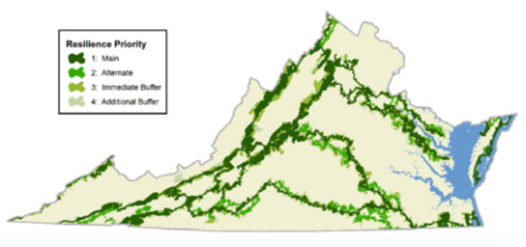
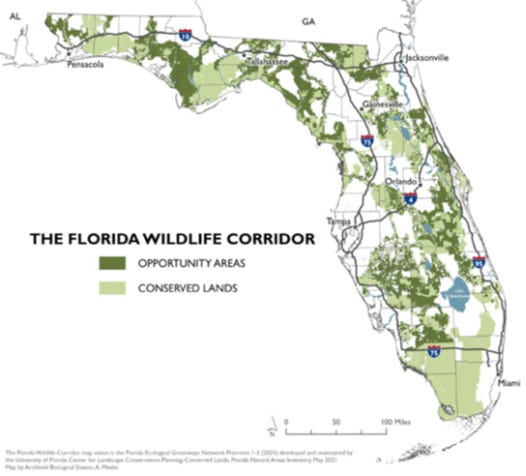
I find it thrilling to think about how the land around me could contribute to a continent-spanning effort to aid wildlife. Central Maryland, according to a recent report by the Climate Change Working Group of Frederick County, could form part of an “Appalachian Climate Corridor.” Species need to migrate as the world warms, and the Appalachian Mountains are already a key a migration route.
Appalachia is a globally important center of biodiversity, with reservoirs of ecological health that carry the potential to contribute to the healing of the region and the world. The mountain range is home to over 250 species of birds, 78 mammals, 58 reptiles, and 76 amphibians, and its mussel, fish, and crayfish richness is unparalleled worldwide. Tennessee alone has at least 290 fish species, more than all of Europe combined.
But these ecosystems are under threat. Almost 200 species found in Appalachia are already federally listed as threatened or endangered, and petitions to protect hundreds more are awaiting action from federal wildlife agencies. As you can see in the Nature Conservancy’s Migrations in Motion map linked here, the central and upper reaches of the Potomac River watershed are part of the migration route for species moving north along the mountains—a route that will become even more important as temperatures continue to rise.
The Blue Ridge Mountains, including the Catoctin and South Mountain ranges of Frederick County, are situated at the Eastern edge of the Appalachian Mountains, enabling them to serve as a bridge for plants and animals needing to migrate upslope and north from the piedmont and the coastal plain. The C&O Canal Park and the Potomac River itself have the potential to serve as corridors too, connecting points East and West with the Blue Ridge Mountains, the Appalachian Trail, and the Allegheny Mountains. And establishment of wildlife corridors would support the healing of the river, especially if they center on its tributaries. Yet the connectivity between these potential corridors is uncertain. Current assessments show some intact forest and a lot of privately owned, largely undeveloped land, but little in the way of durable protections.
Activists here in Western Frederick County are realizing that protections are needed now, before the farms and homesteads that currently predominate are replaced by subdivisions and strip malls, data centers and distribution hubs, all run through with wider, busier roads. We live along the blurry line that is the suburban-rural interface, at the outer edge of the growing sprawl. There is remarkable bipartisan agreement at the level of the citizenry that we should chart a different course; few want Frederick County’s Middletown to become another Ashburn. But the institutions of the mercenary world have us marching in that direction. Wildlife corridors offer a way to soften the blow, preserving some room for wildlife amidst the expansion of human infrastructure that’s mostly incompatible with their thriving.
Intelligence in the landscape
To fully appreciate the power of inviting wildness in, it helps to apply the core idea we’ve explored in prior posts here at Wild Potomac—mutually enhancing relationship between humans and ecosystems. For one thing, because there can be no relationship with something inert, the lens of relationship calls our attention to the intelligence and agency of non-human beings, individually and collectively. This is not to say that the intelligence of an animal, plant, or ecosystem is like human intelligence. But all living beings have the potential to give and take with each other and their environments in ways that enhance the whole, creating, in too many ways to catalog, the conditions for more life. So by making room for wildness, we enable not just a proliferation of organisms, but the emergence and operation of intelligence at the level of ecosystems. That intelligence can be our ally in the project of healing.
The lens of relationship can also help us move beyond mechanistic assumptions and one-way causality, including in how we think about climate change and biodiversity. Yes, warming has dire consequences for wildlife, and increased connectivity can make wildlife more resilient to climate stressors. But climate warming is not a purely mechanistic phenomenon exogenous to the health of ecosystems; a stable climate is part of the life-supporting conditions that healthy ecosystems maintain. Humans are disrupting the Earth’s climate balance by pumping fossil fuels into the atmosphere, turbocharging the greenhouse effect, but also by cutting down forests, tearing up grasslands, paving over wetlands, dredging ocean floors, nitrifying estuaries, poisoning insects, and disrupting Earth’s living systems in a million other ways. The converse is also true: everything we do to protect ecosystems and participate in their healing, including establishing wildlife corridors, contributes to the healing of Earth and its capacity to maintain homeostasis.1
When we adopt the lens of relationship, in other words, we come to see the world around us as full of intelligent beings, and Earth itself as a being. The ground shifts beneath us, and our understanding of the possible shifts too. We can begin to ask not only “what does the river need?,” but even, as Georgian poet Lela Samniashvili does, “what does the river want?”
Life, suppressed
Our dominant institutions, including even our institutions of wildlife conservation, operate from a very different understanding. Far from making space for the intelligence and agency of ecosystems, they control and suppress wildness in countless ways.
A neighbor tells me that once, not so long ago, we had beavers and muskrats around the Potomac River here in Brunswick. He thinks they may have been locally eradicated through trapping, which wouldn’t be unusual. At both the state and federal levels, our government maintains an active program to suppress the population of native mammals. Every year, licensed trappers kill millions of “furbearers,” a category that includes gray and red foxes, weasels, minks, opossums, otters, raccoons, coyotes, fishers, and, in other states, bobcats and wolves. This “population management” is carried out in all our names, based on the belief that the public views these animals as nuisances. The Maryland Department of Natural Resources sees dam-building by beavers, for example, as a threat to commercial forests, agriculture, septic systems, and ornamental trees.
These programs don’t seek to eliminate species outright, but they are successors to the eradication programs of the 18th and 19th centuries in their view that significant local wildlife populations are incompatible with humans. And they operate to maintain populations at levels low enough to eliminate or drastically dilute the effects they once had on the landscape, suppressing the intelligence of these ecosystems. To again take beavers as an example, the North American beaver population, estimated at 60 to 400 million pre-colonization, today hovers around 10 to 15 million. Where once beavers played a key role in bringing life to our lands and waters, today their impact throughout much of the Potomac River watershed is minor or non-existent.
We also suppress wildness systematically and at large scale using poisons. Many states, including Maryland, spray toxic substances from airplanes to kill mosquitos, killing a lot more than mosquitos in the process. According to the Environmental Protection Agency, which authorizes the use of chemicals for this purpose, they are “slightly toxic to very highly toxic” to birds, “moderately toxic” to mammals, and “highly toxic to very highly toxic” to aquatic organisms. One of these substances, naled, is the “pesticide”2 most commonly sprayed from airplanes, and the one used in Maryland.
I even see this pattern—the habit of suppressing wildness—playing out on my street. As I write this, a neighbor is removing a huge maple tree from their yard. In the three years I’ve lived here, on street called Maple Avenue, several large silver maples have been removed within a few blocks of my home. No silver maples, or any other full-size trees that I’m aware of, have been planted. Part of our logic is that a full-size tree could someday require costly maintenance, or even fall onto a house. But already the flocks of starlings and grackles have fewer places to congregate.
I don’t intend to criticize my neighbors. I don’t know why the most recent tree was removed, and it’s possible I would have done the same in my neighbor’s shoes. Sometimes the best choice is to cut down a dying tree before it damages all beneath it. But collectively, as a neighborhood, we are gradually eliminating the few spaces still fit for wildlife amidst our homes. And when I planted two small trees in front of my house a few months ago, the town made me dig them up. Their policy, it turns out, is to prohibit street trees out of concern that they could damage sidewalks or utility lines.
In all of these decisions about how to relate to wildlife, we are choosing management and control over mutual nourishment. The risks to our parochial human interests loom large, while the needs of other species, and of the Earth itself, recede. Even the modest unruliness of a street tree, in this view, is too much wildness.
Wild Potomac is a reader-supported publication. To receive new posts and support my work, consider becoming a free or paid subscriber.
All the world a corridor
If we take a wider vantage, we can see that a vision of the future centered on wildlife corridors remains, despite all their promise, impoverished. Implicit in the call to preserve or establish strips of habitat lurks the expectation that the rest of the landscape—most of it—will remain inhospitable. And perhaps the drive to map hubs and corridors for wildlife, even as it draws upon genuine wisdom and generosity, also reflects habits that are out of place in a relationship of mutuality, like the inclination to confine and control.
What would it look like to imagine instead a future in which wildness emerges throughout the landscape, with humans relating to that emergence as participants and contributors?
One way to start is by turning our yards into havens for wildlife. With his vision of a “Homegrown National Park,” entomologist Doug Tallamy invites us to do just that. He points out that we can dramatically enliven the ecosystems of the continent by replanting the 40 million acres of land across the U.S. currently maintained as ecologically barren lawn with gardens of native plants. For me, the surging movement to support wildlife by planting natives is confirmation that people are ready to embrace relationships of mutuality with non-humans, and that rapid change is possible.
Our food systems could support wildlife too, instead of displacing and destroying it. Farms could become rich mosaics where healthy soil, plant diversity, and human attentiveness make “pesticides” obsolete. And we could shift from annual cropping systems that draw down ancient aquifers towards perennial agriculture where trees (including yellowbud hickories) feed us even as they recharge aquifers, build soil, cool surface water, and shelter animals. Even commercial built spaces could welcome wildlife. Instead of preparing sites by flattening large areas, scraping away topsoil, and leaving the land mostly dead, we could welcome wildlife each time we build, designing for water retention and making space for healthy native trees and plants.
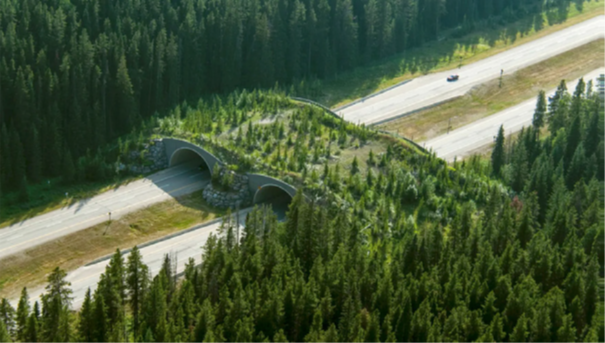
We could redesign our transportation systems to protect wildlife. Already there are efforts to enable wildlife to cross roads and highways safely, like the wildlife bridge in Canada’s Banff National Park shown below and, closer to home, wildlife underpasses along Maryland’s Intercounty Connector highway. We could install such crossings anywhere we continue to use automobiles at high speeds, reducing the devastating toll of roadkill.
True, some species require rarefied habitats, like unbroken interior forest. There’s less potential to invite those species into spaces occupied by humans. But even in those cases, there’s good reason to think we could tend the land in ways that meet their needs and ours. Consider the evidence—including the over-representation of trees used by humans in proximity to past human settlements—that the forests and soils of the Amazon rainforest have been shaped and enhanced by indigenous peoples. Or the testimony of people indigenous to what we call North America that they shaped forests and grasslands in ways beneficial to both humans and other species. The ancient old growth forests of the Potomac River watershed are essentially gone, but they whisper of what’s possible.
We could do all these things and many more besides, not out of obligation, but because they are wondrous, beautiful, and satisfying in their own right. Each is an opportunity to practice what Ivan Illich calls “conviviality”: free and spontaneous action, realized in relationship.
Perhaps no question is more complex than how to make change at the intersection of social and ecological systems. If we think we’ve reasoned out the “right” approach, we’re probably missing something. But intuition can do things rationality cannot, and we respond more skillfully to complexity and context when we heed our embodied mind also. So let’s learn to notice and trust the tug we feel towards certain actions. The best gifts are those we feel called to give.
Leave a Reply